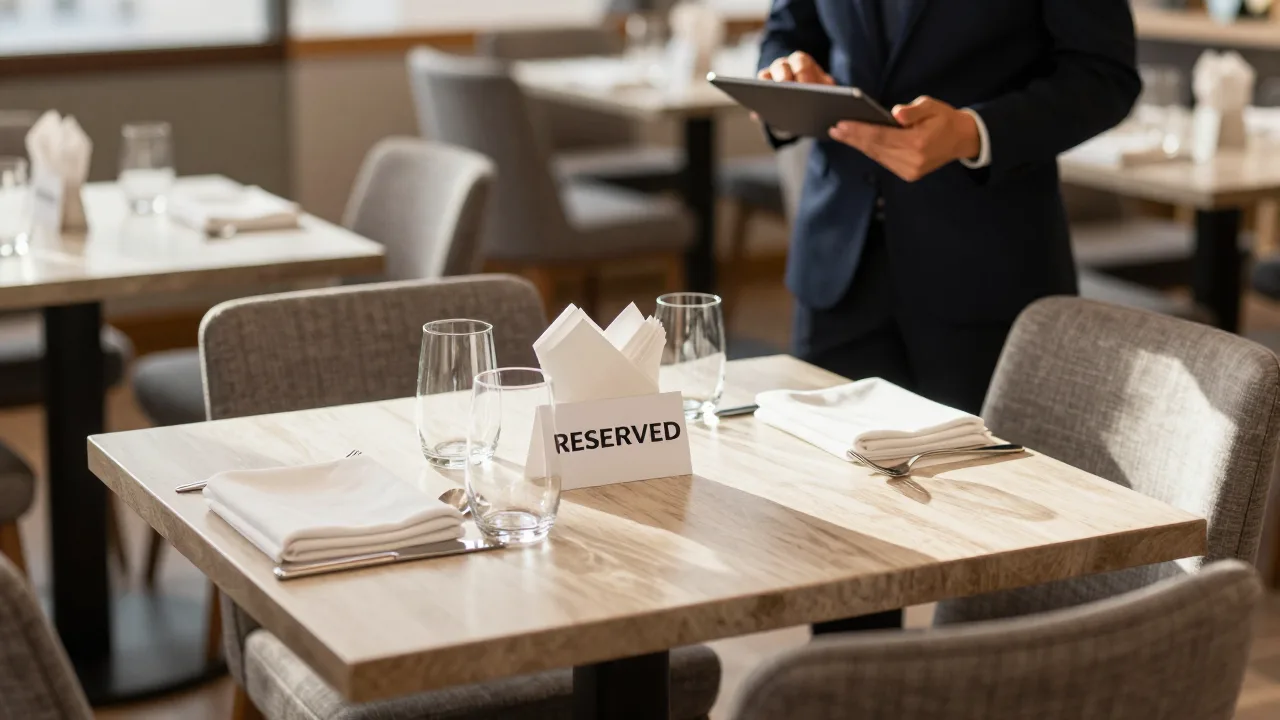
Table blocking is the deliberate act of pulling a table out of the sellable rotation and holding it for a known future use — a party booked at 7:30, a regular who only ever sits at table 42, or two four-tops that need to become an eight-top at eight o'clock. The table sits empty on purpose, and the host stand treats it as unavailable even when guests are standing at the door.
Nearly every full-service restaurant does this, and most do it informally: a circle in grease pencil, a folded napkin, a place card, or a shorthand note only the closing host understands. The intent is sound. A blocked table means the 7:30 booking gets the window seat it asked for, the anniversary couple gets the corner banquette, and the party of nine does not end up split across two rooms.
Here is the tension, though. Blocking is a guest-experience tool that behaves like a capacity tax. Every minute a blocked table stays empty is inventory you cannot sell, and unlike a slow night, you never see it on a report. That is why blocking deserves a real policy rather than a habit — and why the restaurants that manage it well pull noticeably more covers out of the same dining room.
The Four Kinds of Block (and Why the Distinction Matters)
Not all blocks are the same, and lumping them together is the first mistake. Each type has a different justification, a different natural duration, and a different cost profile. Sort them and you can start managing them.
| Block type | Purpose | Typical duration | Cost risk |
|---|---|---|---|
| Reservation block | Protect a specific table for a booked party | 20–90 min before arrival | High — usually over-blocked |
| Preference block | Honor a regular's or VIP's requested table | Whole daypart in weak systems | Very high if untracked |
| Combine block | Hold adjacent tables to build a large top | 30–60 min, multiple tables | Highest — multiplies across tables |
| Service block | Broken chair, HVAC drip, section closed for staffing | Until resolved | Low but often forgotten |
Reservation blocks are the easiest to fix, because their duration is arithmetic rather than judgment. Preference blocks are the most political. Combine blocks are the most expensive, since holding three two-tops to build a six-top runs three streams of lost revenue at once. Service blocks are cheap but sticky — a table flagged for a wobbly leg in March is sometimes still flagged in July.
What a Block Actually Costs
Put numbers on it and the conversation changes fast. Take a 110-seat restaurant with 65-minute average dinner turns, a 3.2-guest average party, and a $38 average check. That is roughly $122 of revenue per turn on a four-top.
Now block that four-top for 90 minutes ahead of a 7:30 reservation. Ninety minutes at 65-minute turns is about 1.4 turns of lost inventory, or roughly $170 in revenue — and it is lost during the exact window when demand is highest and a walk-in was standing at your door. Multiply by the six or seven tables a typical peak Saturday holds open too long and you are at about $1,000 for one service.
A blocked table is the only empty seat in your restaurant that you chose. Which means it is also the only one you can fix without adding a single guest.
Across eight weekend services a month, that is $8,000 in unsold covers. The point is not that you should stop blocking — a block is a purchase, and you should simply know its price.
The Block Window: The Number Most Restaurants Get Wrong
Ask a host when they block a table for a 7:30 reservation and the honest answer is often "when I get in." That is the single most expensive habit in front-of-house operations, and it comes from a reasonable fear: if the table is sold at 6:15 and the party lingers, the 7:30 guests stand in the lobby.
But the fear is solvable with arithmetic. The correct block start time is the reservation time minus one typical turn for that table type minus your reset time. If your four-tops turn in 65 minutes and a reset takes 5, the last safe seat time before a 7:30 booking is 6:20. Any walk-in seated before 6:20 will be gone with time to spare.
| Reservation | Table type | Typical turn | Reset | Block starts |
|---|---|---|---|---|
| 7:30 PM | Two-top | 55 min | 5 min | 6:30 PM |
| 7:30 PM | Four-top | 65 min | 5 min | 6:20 PM |
| 7:30 PM | Six-top booth | 85 min | 8 min | 5:57 PM |
| 7:30 PM | Combine (2×4-top) | 65 min each | 12 min | 6:13 PM |
Notice what that does: it converts an anxious guess into a posted rule. A host who blocks the four-top at 5:30 instead of 6:20 donates 50 minutes of prime inventory to nobody — and six of those is most of an early seating.
The one adjustment worth making is a buffer for tables you know run long — the corner booth where parties camp, or anything with a tasting menu on it. Add 10 to 15 minutes to those specific tables rather than padding every block across the board.
Five Rules That Keep Blocking Honest
Policy beats instinct here, and the policy can fit on an index card at the host stand. These five rules do most of the work:
- Every block has a start time, not just an end time. Calculate it from the turn table above and write it on the block. A block with no start time is a block that starts at open.
- Every block has a reason code. Reservation, preference, combine, or service. If a host cannot name the reason, the table goes back in the pool. Reason codes are also what make block cost reportable later.
- Every block has an auto-release. Set a grace period — 10 to 15 minutes past the reservation time is standard — after which the table returns to sellable inventory. This is the same discipline that drives good no-show reduction, applied to your own floor plan.
- Preference blocks need a tier. Decide who qualifies: top loyalty tier, confirmed booking, or manager approval. "Someone said they were a regular" is not a tier.
- A manager sweeps blocks hourly. Five minutes at the top of each hour to walk the chart and kill stale blocks recovers more covers than almost any other host-stand habit.
Restaurants that adopt these five rules usually find their peak-hour blocked-table minutes drop by 40 to 60 percent in the first month — without a single reservation being mishandled. The blocks that remain are the ones that were genuinely worth buying.
Example scenario: a 96-seat restaurant running 45-minute waits with five to eight tables blocked
Illustrative scenario — a composite example built to show how the numbers work. It does not describe a real business or customer.
Consider a 96-seat neighborhood American restaurant running 45-minute weekend waits while its own seating chart shows five to eight tables blocked at any moment during peak. Blocks are drawn in grease pencil at the start of each shift with no start times and no release rule.
Before: An average of 7.2 tables blocked between 6:00 and 8:00 PM, average block duration 82 minutes, and roughly 26 percent of blocked tables never used by the party they were held for.
Change: Posted turn-time table at the host stand, reason codes on every block, a 12-minute auto-release, and an hourly manager sweep. No new hardware in month one.
After 60 days: Average blocks during peak fell to 3.1, average duration to 41 minutes, and unused blocks to 6 percent. Weekend covers rose by 38 per night — about $1,430 in incremental weekend revenue — with no change in reservation complaints.
Blocking for Combines and Large Parties
Combines deserve their own treatment because the cost scales with the number of tables involved. Holding three two-tops from 6:00 for an eight o'clock party of six means you have taken three revenue streams offline simultaneously, and the arithmetic gets ugly quickly: three tables × 120 minutes × roughly one turn each is easily $250 to $300 in lost covers for a single booking.
The fix is staggered blocking. Block the tables in reverse order of expected free time — the one most likely to still be occupied first, the fastest-turning one last. If your two-tops turn in 55 minutes, the last table in the combine needs a 60-minute head start, not 120.
It also helps to designate combine-friendly zones during floor plan design so the same two or three groupings handle almost all your large parties. Fixed combine zones make the block predictable, keep servers' sections balanced, and stop a party of ten from carving a hole through the middle of your best section. Our guide to complete table management covers how those zones interact with section design.
Where Software Changes the Math
You can run good blocking discipline on paper — the restaurant in the example above did for two months — but software changes the economics in three specific ways, and none of them are about the block itself.
First, blocks become time-aware. The system knows the reservation time, the table's historical turn time, and the current queue, so it can propose the block start time instead of asking the host to compute it. It can also refuse to block a table more than one turn ahead of the booking, which enforces the rule quietly.
Second, blocks expire on their own. A configurable grace period returns a late party's table to sellable inventory without anyone remembering to do it, and routes them to the next equivalent table when they arrive.
Third — and this is the one operators underrate — blocks become reportable. When every block carries a reason code and a duration, your weekly numbers show blocked-minutes by reason, by daypart, and by host. Suddenly you can see that Tuesday's preference blocks cost $180 and Saturday's combine blocks cost $640, and you can decide whether both were worth it. That visibility pairs directly with the way a modern digital reservation system tracks booking behavior, and with the queue data your waitlist management already collects.
If you want to size the opportunity before changing anything, run your current numbers through a calculator that shows what each additional turn is worth — blocked minutes convert directly into that figure, and the result is usually larger than operators expect.
Common Table Blocking Mistakes
These are the patterns that show up again and again when we look at a floor with a blocking problem:
- Blocking at shift start. The default that costs the most. Every block should have a computed start time, and almost none of them are "now."
- Blocking the best table for every VIP. If the window four-top is held for a regular three nights a week, it is not a table anymore — it is a private dining room you are not charging for.
- Holding a block past a no-show. Ten minutes of grace is hospitality. Forty minutes is a donation. Set the number and let the system enforce it.
- Blocking whole sections for staffing. Closing a section because you are one server short is sometimes right, but it is a capacity decision, not a blocking decision — and it should go through the same math you would apply to section balancing.
- Never reviewing the data. If nobody looks at blocked minutes weekly, the discipline decays within a month. Put it on the same report as covers and turn times.
Putting It Together
Table blocking is not a problem to eliminate — it is a cost to manage. The restaurants that handle it well do four things: they classify every block by reason, they compute the start time instead of guessing it, they attach an automatic release, and they review the cost every week. That combination protects the reservation, protects the regular, and stops your best tables from sitting empty during the only two hours that really matter.
The upstream half of the equation matters too. When your booking flow, your quoted wait times, and your floor status share the same data, blocks stop being defensive guesses in the first place — something covered well in this practical walkthrough of running reservations alongside walk-ins. And when you shorten the turns themselves, every block gets cheaper automatically, which is why blocking policy and turnover improvement belong in the same conversation.
KwickOS ties reservations, the waitlist, live table status, and POS into one floor view, so blocks carry reason codes, compute their own start times, release themselves when a party is late, and show up as a line you can actually manage.
Stop Paying for Empty Tables You Chose
KwickOS calculates block windows from your real turn times, auto-releases late blocks, and reports blocked minutes by reason — so you protect the reservation without giving away the peak. Join 5,000+ restaurants and start free, no credit card needed.
Start Your Free TrialSell the System That Pays for Itself in Recovered Covers
Every operator you talk to is over-blocking tables and does not know it. KwickOS resellers earn recurring revenue on the all-in-one platform that ties the whole floor together.
Join the Reseller Program