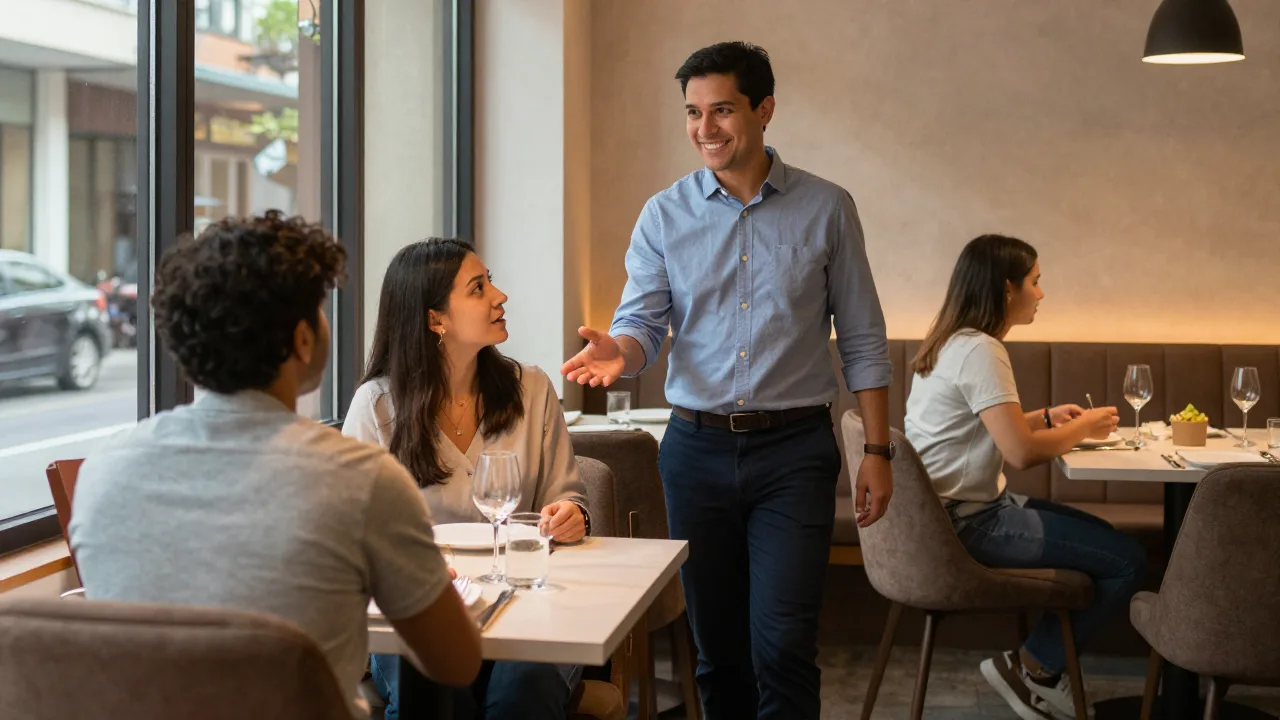
Somewhere between 18 and 22 percent of booked parties at a full-service restaurant arrive wanting something specific about where they sit. On anniversary-heavy weekends and holidays it passes 30 percent. That is not an edge case — it is a fifth of your book, every night, applying pressure to a floor plan that was designed without them.
What makes it costly is that most restaurants have exactly one response to a request: hold the table. A guest who says "somewhere quiet, please" and a guest who says "table 12 or nothing" get the same treatment, which means the cheap request gets honored expensively and the expensive one gets honored without anyone checking the price. Meanwhile the regular who has sat in the same booth for six years watches a new host seat someone else there, because the note lived in a departed manager's memory.
Both problems have the same root: requests are not classified, not priced, and not stored anywhere durable. Fix those three things and a fifth of your book turns from a nightly negotiation into a reliable source of loyalty.
The Two Kinds of Request — and Why the Split Matters
Start by splitting every request into hard or soft. A hard request names one table and can only be satisfied by that table. A soft request describes a quality — a booth, a quiet corner, away from the door, near the window — that three or four tables could satisfy equally well.
The distinction is worth real money, because soft requests can be matched at the moment of seating rather than protected in advance. No block, no held inventory, no cost. In practice about three-quarters of requests are soft, which means most restaurants are holding tables for asks that never required a hold.
| Request | Type | Tables that satisfy it | Cost to honor |
|---|---|---|---|
| "Table 12, please" | Hard | 1 | High — requires a block |
| "A booth if possible" | Soft | 4–8 | None — matched at seating |
| "Somewhere quiet" | Soft | 5–10 | None |
| "Not near the kitchen door" | Soft (exclusion) | Most of the room | None |
| "Wheelchair-accessible seating" | Requirement | Designated tables | Non-negotiable |
Notice the last row. Accessibility needs are not requests at all — they are requirements, and they get planned capacity rather than case-by-case judgment. Treating them as preferences is both an operational failure and a legal one, which is why they belong in your accessible seating plan rather than in the request queue.
What Saying Yes Actually Costs
Hard requests deserve arithmetic, not instinct. Holding a specific table for a 7:30 party means that table stops earning for roughly one turn before they arrive. On a four-top in a room with 65-minute turns, a 3.2-guest average party, and a $38 check, that is about $122 of forgone revenue — sometimes more if the request lands on a prime table at peak.
Now run it the other way. If honoring that request keeps a guest who visits twice a month at an average spend of $95 per visit, you are protecting roughly $2,280 a year for a $122 cost. That is an easy trade, and it should be made deliberately rather than by default.
The question was never "should we honor requests." It is "which requests are worth a turn, and do we know who is asking?"
The same $122 spent on a first-time guest who names a table because they saw it on social media is a different decision entirely. Not a wrong one — just one you should make with the number in front of you.
Capturing Preferences So They Outlast the Shift
Here is where most systems quietly fail: preferences get typed into a reservation note, which dies when that booking closes. The guest returns three months later and the restaurant has forgotten everything it learned.
Preferences belong on the guest profile, not the booking, and they need structured fields rather than a paragraph of prose. Free text only works when the right person happens to read it at the right moment. Structured fields can be matched by the system at seating time and surfaced to the host automatically. Five fields cover almost everything:
- Preferred zone — main room, patio, bar, back dining room.
- Preferred seat type — booth, banquette, high-top, counter, standard table.
- Accessibility need — a separate flag, never mixed with preferences.
- Avoid list — near the kitchen door, under a vent, next to the service station.
- Source and date — who recorded it and when, so stale notes can be retired.
That last field earns its place. A preference recorded in 2022 by a server who has since left, on a table that was removed in a remodel, is worse than no preference at all — it makes the host stand distrust the whole profile. Anything older than 18 months without reinforcement should be flagged for confirmation rather than acted on blindly. For the broader mechanics of building profiles that stay useful across visits, this walkthrough of tracking guest preferences from one visit to the next covers the data side in more depth.
Example scenario: a 118-seat neighborhood restaurant holding 4.6 tables a night for named-table requests
Illustrative scenario — a composite example built to show how the numbers work. It does not describe a real business or customer.
Consider a 118-seat neighborhood restaurant with a strong regular base that holds an average of 4.6 tables per weekend service for named-table requests — and honors only 61 percent of the soft requests guests have actually made, because those notes are buried in free-text reservation fields.
Before: Every request treated as a hard hold. Roughly $560 per weekend night in blocked-table revenue, and repeat guests regularly seated against preferences the restaurant had already recorded.
Change: Split requests into hard and soft at the point of booking, moved preferences to structured guest-profile fields, and set a rule that hard holds at peak required either top-tier loyalty status or manager approval.
After 90 days: Hard holds fell to 1.4 per service, soft-request satisfaction rose to 88 percent, and blocked-table cost dropped by about $400 a night. Repeat-visit frequency among profiled regulars rose 12 percent over the quarter.
A Decision Rule Your Host Team Can Actually Apply
Judgment calls at a busy host stand need to fit in one breath. This four-step rule does:
- Is it an accessibility requirement? Then it is not a request. Seat it, and make sure your designated tables are protected as capacity rather than blocked ad hoc.
- Is it soft? Then say yes and match it at seating. No block, no approval, no cost. This alone resolves three requests in four.
- Is it hard and off-peak? Say yes. A block at 5:45 on a Tuesday costs almost nothing, and the goodwill is identical to a block at 7:30.
- Is it hard and at peak? Check the guest tier. Top-tier regular or confirmed booking with a deposit: honor it. Otherwise offer the alternative script below.
The guest tier in step four is the only part requiring setup. You need a visible signal at the host stand for who qualifies — visit frequency, lifetime spend, or membership in a recognition program. The structure behind that signal is worth getting right, and there is a solid framework for it in this guide to building a recognition program for your highest-value regulars.
How to Decline Without Losing the Guest
Saying no badly costs more than the table you saved. Saying no well is a three-part move: acknowledge the request specifically, name the constraint in a single sentence, and offer a concrete alternative — ideally two.
Compare the two versions. "I'm sorry, that table isn't available tonight" invites disappointment and nothing else. "Table 12 is booked through nine — I can put you in the corner booth in the same room, which is just as quiet, or hold 12 for you at 9:15" gives the guest agency and demonstrates that the request registered.
Two habits make this work at volume. First, the host should know which tables actually substitute for which, so alternatives are credible rather than random — that mapping lives in your floor plan, not in someone's head. Second, log the declined request on the profile. A guest whose request you turned down twice should be an obvious yes the third time, and only a written record makes that possible.
Where Technology Earns Its Keep
Preference management is one of the few areas where software changes what is possible rather than just making it faster. Three capabilities matter.
Automatic matching is the first. When preferences are structured, the system can propose the best available table for an arriving party rather than asking the host to remember. Soft requests get satisfied at a rate no manual process reaches, because the matching happens at the moment of seating with full knowledge of the floor.
Surfacing is the second. The preference has to appear where the host is already looking — on the arrival card, in the waitlist entry, on the table map — not two screens deep in a guest record. This is the practical argument for consolidated host stand technology: a preference nobody sees is a preference nobody honors.
Continuity is the third and most valuable. When preferences persist on the profile, they survive staff turnover, POS changes, and the six months between a guest's visits. That continuity is also what separates a modern digital reservation system from a phone-and-notebook process, and it feeds directly into the queue data your waitlist already collects for walk-in parties who have preferences too.
Mistakes Worth Avoiding
- Recording preferences on the booking instead of the guest. The single most common failure, and it erases everything you learn.
- Treating accessibility needs as requests. They are planned capacity with a legal floor, not a courtesy.
- Honoring hard requests silently at peak. If nobody logs the cost, nobody can decide whether it was worth it.
- Free-text notes with no expiry. Stale preferences make hosts distrust the whole system within a season.
- Promising a specific table on the phone. A promise made at booking becomes an obligation at 7:30 regardless of what the floor looks like. Promise the quality, not the number.
The Takeaway
Classify every request as hard or soft, honor the soft ones automatically because they are free, price the hard ones against a turn before you commit, store preferences as structured fields on the guest profile with a date stamp, and give hosts a two-alternative script for the times the answer has to be no. Restaurants that do this hold fewer tables and satisfy more guests at the same time — which sounds contradictory only until you notice how many held tables were never needed.
KwickOS keeps guest preferences on the profile, matches soft requests against live floor availability at seating time, and shows the host the preference and the guest's history on the same screen as the table map.
Remember Every Regular, Hold Fewer Tables
KwickOS stores seating preferences on the guest profile and matches them to open tables the moment a party arrives — so you honor more requests while blocking far less inventory. Join 5,000+ restaurants and start free, no credit card needed.
Start Your Free TrialSell the System That Makes Regulars Feel Known
Guest recognition is the feature operators ask about and rarely have. KwickOS resellers earn recurring revenue on the all-in-one platform that ties the whole floor together.
Join the Reseller Program