Average Table Turn Time by Restaurant Type: Benchmarks and How to Measure Yours
Why Benchmarking Table Turn Time Matters
You can't improve what you don't measure, and you can't set goals without a reference point. The ranges below are the rules of thumb operators and consultants commonly work from for each restaurant type. They are planning figures, not a scientific dataset — your own POS records are the only benchmark that truly matters, and the method for pulling them is at the end of this article.
What every operator who tracks this discovers is enormous variation, even within the same category. Two casual-dining restaurants with the same menu and the same seat count can differ by 15 minutes or more per turn, and at a busy dinner service that difference is worth several extra parties a night — pure revenue on a fixed rent and labor base.
The Numbers: Average Turn Times by Category
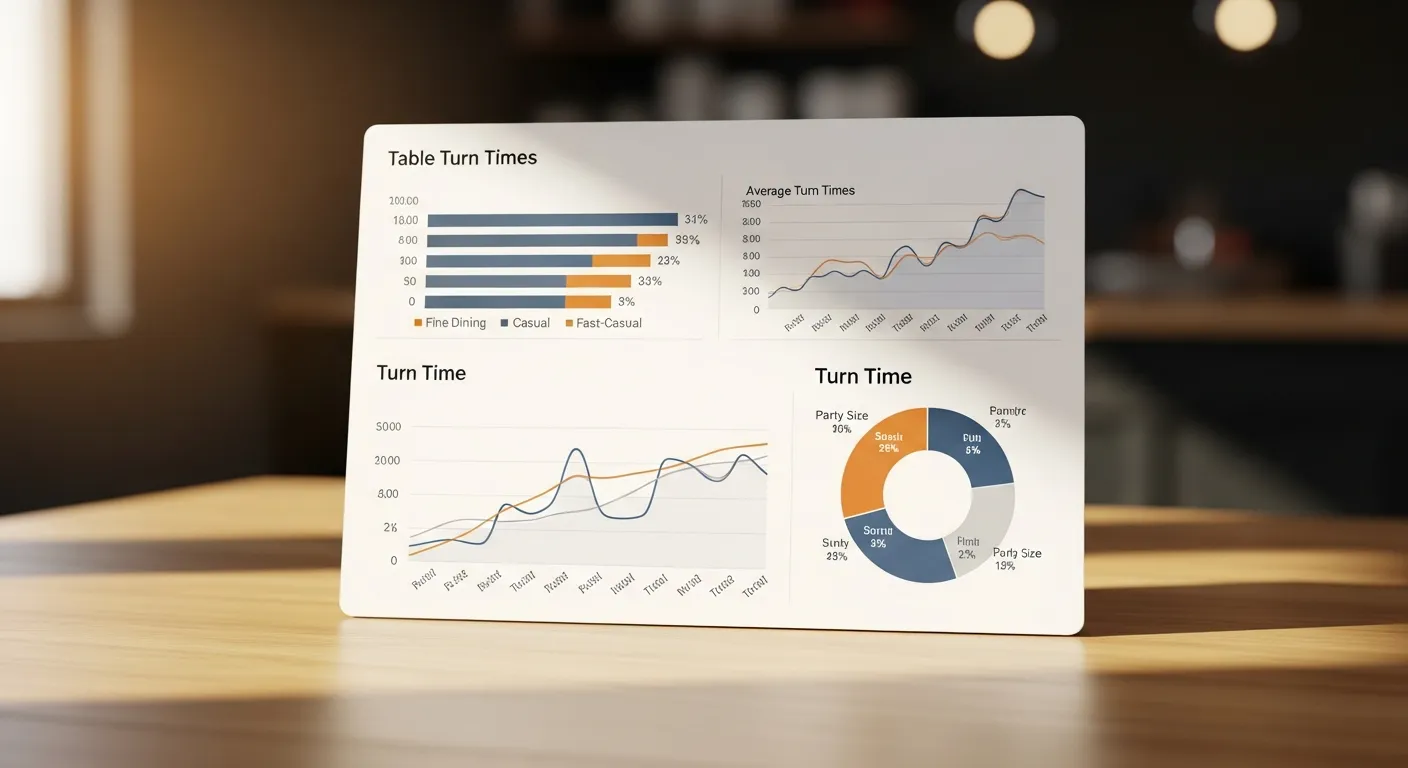
Fast casual: typically around half an hour from order to departure. The fastest operations use self-ordering kiosks or QR code ordering that eliminates server ordering time entirely. The slowest have long counter lines and slow kitchen throughput.
Casual dining (2-tops): roughly 45 minutes to an hour. The gap between a typical restaurant and a well-run one is almost entirely dead time — waiting for menus, waiting for the check, waiting for table reset. Casual dining (4-tops): closer to an hour or more. Larger parties add complexity in ordering, splitting checks, and coordinating departures.
Fine dining: an hour and a half to two hours or more. Turn time varies dramatically with the number of courses — a three-course dinner is a very different sitting from a seven-course tasting menu. Fine dining should optimize for per-person spend, not turn speed.
Day-of-Week and Time-of-Day Patterns
Weekday lunch turns are noticeably faster than weekend dinner turns in every category. This isn't surprising — lunch diners are often on a time constraint. The opportunity is usually weekday dinner, where turns are faster than the weekend but occupancy is lower. Faster turns + empty tables = wasted potential.
Peak hours (6:30-8:30 PM) often show slower turns than off-peak — counterintuitively. The culprit: kitchen bottlenecks. When every table orders simultaneously, food delivery slows, extending the gap between ordering and eating. Restaurants that stagger reservation times by 10-minute intervals avoid this kitchen pileup and maintain consistent turn times throughout the evening.
What Separates Top Performers
Restaurants that consistently turn tables efficiently tend to share five habits: they use digital table management software (not paper reservation books), they pre-bus consistently on every table, they keep table reset times under 3 minutes, their POS is integrated with their table management system, and they measure and review turn data weekly.
Notably, efficient operators don't sacrifice guest satisfaction. Faster turns through dead-time elimination go hand in hand with better reviews — because guests spend less time waiting and more time enjoying.
How to Calculate Your Restaurant's Turn Time
Step 1: Pull your POS data for the last 30 days. For each table, calculate the time between first order and check close. This is your 'service time' — the part of the turn the guest experiences.
Step 2: Track reset time separately. Have a manager time 20 table resets across different shifts. Average this. Add service time + reset time + average seat-to-order time (typically 5-8 minutes) = total turn time.
Step 3: Compare to the ranges above and, more importantly, to your own best shifts. If your turns run longer than the typical range for your category, prioritize the dead-time elimination strategies. If they run shorter but guests are waiting for food, investigate kitchen throughput and staffing levels — you may have a speed problem, not a dead-time problem.
Ready to Upgrade Your Restaurant?
KwickOS: table management, waitlist, POS, online ordering — all in one platform. 5,000+ restaurants trust us.
Get a Free Demo →Become a KwickOS Reseller
Earn recurring revenue bringing KwickOS to restaurants in your area. Exclusive territories available.
Apply Now →